
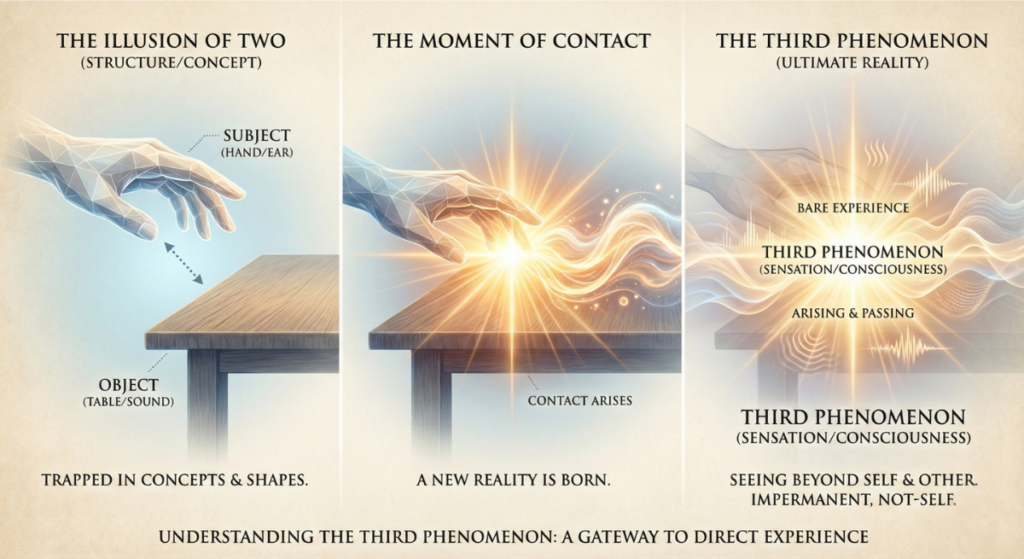
Understanding the Third Phenomenon: A Gateway to Direct Experience
I want to explain a profound concept that is essential for your practice—the third phenomenon (တတိယတစ်ခု). In our daily lives, we are often trapped in the world of concepts and shapes, which we call structure (အထည်ခန္ဓာ). We see ourselves as a solid “ person” interacting with solid “ objects.” To break free from this illusion and see the truth of anattā (not-self), we must learn to see the third reality that arises in every moment of contact.
The Illusion of Two: Subject and Object
Usually, our mind operates in a binary way. When you touch a table, you think, “ I am touching the table.” In your mind, there are only two things: the “ Hand” (the subject) and the “ Table” (the object). Because you only see these two conventional entities, the “ I” remains solid. You feel that “ I” am the one controlling the action and “ I” am the one experiencing the sensation.
This is the trap of Sakkāya-diṭṭhi (personality belief). As long as you are stuck in this duality, you are seeing only the conventional reality (Samuti). You are not yet seeing the ultimate reality (Paramattha). We must move beyond seeing just the hand and the object to find the truth that lies between them.
The Mirror Analogy: Seeing Beyond Self and Other
I want you to understand that when two things come into contact, a completely new, distinct reality is born. This is what I call the third phenomenon. I often use the analogy, which comes from the Venerable Ledi Sayadaw, of looking into a mirror to illustrate this teaching. When you stand before a mirror, an image appears. Now, consider carefully: that image is neither the mirror itself nor you as the person looking. It is a third phenomenon that newly arises when conditions meet. This image is what we call “ āgantuka” (a temporary visitor)—it exists only momentarily, not permanently. When you move away from the mirror, the image ceases. When you return, it appears again. This is the nature of all phenomena arising through contact.
Similarly, when I speak to you now, my voice is “ one,” your ear is “ two,” and the hearing consciousness (sota-viññāṇa) that arises from their contact is “ three.” This hearing consciousness cannot arise earlier, before the sound reaches your ear. It cannot arise later, after the sound has passed. It arises precisely when causes coincide and ceases when causes are absent. This is what I mean by the third phenomenon—it is just the bare quality of hearing, nothing more.
Take another example: rubbing your hands together or touching a surface. There is the hand (1) and the surface (2). But the moment they touch, a sensation—a “ hardness,” “ warmth,” or “ pressure” —appears (3). This sensation is not the hand, and it is not the table. It is a functional reality (သဘောခန္ဓာ) that exists only for that moment of contact.
Breaking Free from “ I” and “ Other”
When I teach you to be mindful of the third phenomenon, I want you to understand that we are not seeking concepts (paññatti). We don’t want notions of “ I” and “ other.” Rather, we wish only to attend to the bare experience: just the quality of hearing, just the quality of touching, just the quality of tasting, as it is. This is how you should contemplate.
Let me explain this more deeply through the teaching of ārammaṇapaccayo (object condition) from the Paṭṭhāna. Consciousness arises only when there is a sense-object. When we think the sound is what “ he” speaks, and hearing it is what “ I” perceive, we create the duality of “ he” and “ I.” But the Buddha taught that in reality, there is no “ I” or “ other” —only sense object (ārammaṇa) and consciousness (citta) exist. If you remain aware of just the nature of hearing, you transcend the two extremes of “ he speaks, so I hear.”
Learning Step by Step: The Present Moment in Daily Life
Now, I want to help you understand this practically. Sound is “ one,” ear is “ two,” the hearing consciousness that arises from their contact is “ three.” Likewise, foot is “ one,” floor is “ two,” the sensation of touch that arises when the foot makes contact with floor is “ three.” Similarly, food is “ one,” tongue is “ two,” the taste-consciousness that arises when the food makes contact with the tongue is “ three.” This is how you have to learn it, step by step.
When your foot touches the floor, the sensation of touch arises. If your foot is “ one” and the floor is “ two,” then knowing that sensation of contact is “ three.” This is what I call the “ third phenomenon” to help you understand how to observe the present moment. Being mindful of the third phenomenon in the present moment means that both the foot and the floor disappear, perceiving only the distinct touch sensation. You will begin to see these qualities of touch, these rūpa (materiality) and nāma (mentality) of touch arising and passing, one after another, when walking.
The Example of the Hot Pot Lid
Consider another example I often teach. Imagine a hot pot lid. When you touch it, you say, “ The lid is hot.” But think carefully. Is the heat sitting in the lid? Is the heat in your hand?
The truth is, the “ heat” is the third phenomenon. It arises because of the collision between the sensitivity in your hand and the temperature element in the lid. The heat is a new reality that is born from that contact. We usually make the mistake of thinking “ The lid is hot” (attributing the quality to the object) or “ I feel hot” (attributing the experience to the self). But in reality, there is just the arising of heat—a natural process, a third element born from conditions.
My Personal Experience: When Concepts Dissolve
Let me share with you something from my own practice that truly illustrates this teaching. One morning while washing my face, I was being mindful. Suddenly, both my hands and face completely vanished from my perception. The sudden absence startled me, and I quickly opened my eyes, only to find my hands and face reappearing in view. It was truly shocking. At that moment, I realized something profound: when washing my face, the experience does not consist of “ hands” and “ face” but rather a sequence of distinct touch sensations occurring one after another.
Later, while brushing my teeth, a similar phenomenon occurred. Both the toothbrush and my teeth vanished from my perception; what remained were only the sensations of pressure and movement. Such a level of concentration is essential for insight. Even if you haven’t achieved this yet in your meditation practice, you can be mindful and focus your attention in this way. As you continue practicing, you will gradually understand. You will truly see the pushing and pressing sensations.
When wiping my face with a towel, both the towel and face disappeared, and only the sensations of touch appeared in my mind. When I turned on the faucet and put my hand in the water, I perceived the sensations of pressure and coldness. Water and hand no longer appeared in my mind. For example, if you reach out and hold a glass with ice in it, it will feel cold. When it’s cold, your mind might immediately label it as “ ice.” But that’s not correct. You’re actually just perceiving coldness. The ice disappears, the hand disappears. These realizations will emerge in your mind.
Materiality and Mentality: The Ultimate Reality
This is why, when observing the “ third phenomenon” with mindfulness, you perceive the processes of stiffness and softness, pushing and resistance as materiality (rūpa), while awareness of these sensations is mentality (nāma). Over time, you become accustomed to living with these ultimate realities (paramattha) of materiality and mentality. These ultimate realities also cease and disappear where they arise.
Later, I started a habit: whenever I encountered handrails, I would touch and rub them with my hand. When touching the handrail beside me, I couldn’t see it, but my mind registered the successive moments of contact between my hand and the rail. What happens with each contact? They’re arising and passing away—these contemplations became more frequent.
The Power of Contact and Knowing
Great masters like Sunlun Sayadaw and Webu Sayadaw became Arahants (fully enlightened ones) by being acutely mindful of these two things: the contact and the knowing of it. For us, we struggle to even understand the basic process of contact and knowing. Contact (touch) is materiality (rūpa), awareness (knowing) is mentality (nāma). These materiality and mentality—these contact and awareness—arise when conditions meet and cease when conditions end. Nothing can be grasped as “ mine” or “ belonging to me.”
Even in in-breath and out-breath, there are just contacts and knowings, pressures and movements. The pressure or movement is materiality (rūpa), while the knowing is mentality (nāma). In the experience of touch, the touching is materiality (rūpa), and the knowing is mentality (nāma). When walking, contact occurs when foot and floor meet, creating a touch sensation. When they separate, the sensation no longer exists. By being acutely mindful of just this, the great masters became Arahants.
Transcending Wrong View: Understanding Sakkāya-Diṭṭhi
People hold wrong views about the aggregates of materiality and mentality that exist in the world, with the view of self—as “ I,” “ you,” or “ others,” perceiving them as individual beings or persons. This view is called sakkāya-diṭṭhi (the wrong view of self), and it arises due to the presence of greed rooted in craving (taṇhā). Within the physical body, the earth element (paṭhavī dhātu) characterized by hardness is grasped as “ mine” with craving leading the way.
The proof that the earth element is not a person or being is that the earth element is the fundamental solid basis in the form of a being. Only when you can distinctly discern the mere hardness with wisdom can you gain the ultimate understanding of the earth element (paramattha). If you don’t know this, then sakkāya-diṭṭhi arises in the mind, such as “ My head is hard,” “ My foot is hard,” or “ My bones are hard.”
When hardness is known, there is no “ head” in ultimate reality. Only the earth element characterized by hardness truly exists. This is the sammā-diṭṭhi-ñāṇa (right-view wisdom) that distinctly perceives the earth element. Distinctly grasping what the preceding mind-moment knows means this: If the hand is “ one” and the table is “ two,” when the hand touches the table, a quality of hardness will arise. That hardness is “ three.” At that point, the concepts of “ hand” and “ table” disappear. Distinctly grasping means focusing just on that hardness.
The Preceding and Subsequent Mind-Moments
Hardness is experienced only when there is contact with the hand. As soon as you release, the hardness is gone. You cannot experience hardness beforehand, nor does this quality of hardness remain afterward. At the moment of contact with the hand, body-consciousness (kāya-viññāṇa) arises and knows the quality of hardness. The hardness is materiality (rūpa); the arising of body-consciousness (kāya-viññāṇa) is mentality (nāma). The materiality and mentality at the moment of contact are the present moment.
If the preceding mind-moment knows just the bare hardness, it’s paramattha-knowing (ultimate knowledge). But if the subsequent mind-moment knows it as “ the stone is hard,” “ the table is hard,” or “ the forehead is hard,” then it’s paññatti-knowing (conventional knowledge). The knowing in the preceding mind-moment is kāya-viññāṇa (body-consciousness)—direct consciousness (viññāṇa). Only with the subsequent mind-moment comes mind-consciousness (mano-viññāṇa).
The Present Moment: Seeing, Hearing, Touching
The materiality and mentality (rūpa and nāma) at the moment of hearing are in the present moment. What you’re hearing right now is all in the present moment. It’s precisely in the present moment. You don’t hear before I speak. You don’t hear before the sound exists. And once the sound is gone, the hearing consciousness no longer exists. So, the sound is materiality (rūpa), and the hearing is mentality (nāma). The materiality and mentality at the moment of hearing are in the present moment.
This is easy once you know it, but if you don’t, the concept of the “ present moment” doesn’t register in your understanding. When you hear now, it’s the present moment. When you open your eyes and see, it’s also the present moment. At the moment of seeing, you can’t see one second into the past, nor can you see one second into the future. So, if your mindfulness becomes truly aligned with the understanding that “ the present moment is just these moments of seeing, hearing, smelling, tasting, touching, and thinking,” then clarity will be established.
From Understanding to Liberation
The present moment arises due to the coinciding of causes and conditions—like ear and sound coming into contact—and ceases when those conditions end. When it becomes clear that materiality and mentality are impermanent, attachment is abandoned. We tend to take these materiality and mentality to be a permanent “ I” —” me yesterday” and “ me today.” We perceive them as permanent (nicca). So, once you realize that nothing is permanent, there’s nothing to cling to. When attachment is abandoned, there is liberation.
The Path Forward: Continuous Practice
This awareness of contact sensation is what I want to emphasize. “ Be mindful of the third phenomenon, observe the present moment directly” is truly an important practice. Try to contemplate this. Your concentration will improve. Due to the power of repetition (āsevana-satti), as you cultivate it again and again, materiality (rūpa) and mentality (nāma) will become clearer and more vivid in your mind. You will come to understand these things gradually, and as you continue practicing, you will truly see the nature of reality as it is—impermanent, unsatisfactory, and not-self.
Dr. Soe Lwin (Mandalay)
Teaching & Quiz
The Third Phenomenon
A Gateway to Direct Experience
The Illusion of Structure
In daily life, we are trapped in the concept of “ structure” . We see a solid “ I” interacting with solid “ objects.” To break this illusion and see anattā (not-self), we must perceive the Third Phenomenon that arises at the moment of contact.
The Math of Experience: 1 + 2 = 3
Usually, we think in binaries: “ I” (Subject) and “ Object” . But the Buddha taught a triad:
- 1 The Sense Door (e.g., Ear, Hand)
- 2 The Object (e.g., Sound, Surface)
- 3 The Third Phenomenon (Consciousness/Sensation)
“ Sound is one, Ear is two, Hearing Consciousness is three.”
The Mirror Analogy
When you look in a mirror, an image appears. The image is neither the mirror nor you. It is a temporary visitor (āgantuka) that arises only when conditions meet and vanishes when you leave.
The Hot Pot Lid
Touching a hot lid: The heat is not “ in” the hand, nor “ sitting in” the lid. The sensation of heat is the Third Phenomenon born from the collision of sensitivity and temperature.
Practical Application
The goal is to move from Paññatti (Concepts: “ I am washing my face” ) to Paramattha (Ultimate Reality: “ Pressure, coldness, movement” ).
“ When washing my face, hands and face vanished. Only a sequence of distinct touch sensations remained.”
By focusing on the contact (Rūpa) and the knowing of it (Nāma), we realize everything is impermanent. When attachment to a solid “ self” is abandoned, liberation follows.
Loading Question…
Practice Complete
You scored 0 out of 10