
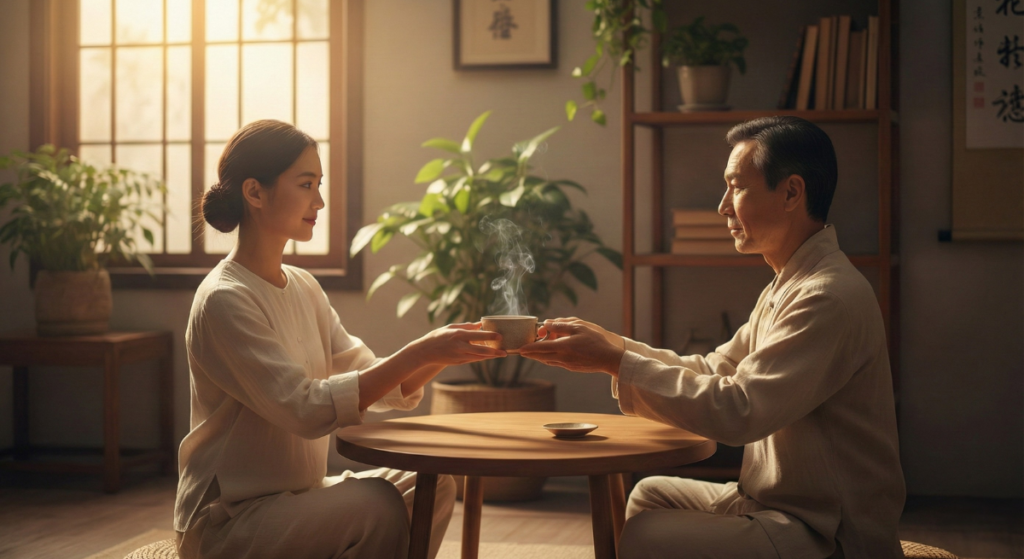
The Profound Practice of Coffee Meditation: Transforming Daily Life into the Path
I want to share with you one of the most practical and accessible methods I have developed for bringing the Dhamma into everyday life—what I playfully call “ Coffee Meditation.” Many people think that meditation is something special, something that can only be done in a retreat center or a quiet monastery. They imagine it as a burden, an extraordinary effort separate from ordinary existence. But this is not the truth at all. The world and the Dhamma are not separate; they are one and the same. The real question is: how do we apply insight-wisdom (ဉာဏ်ကုသိုလ်) in our daily activities, in the simple actions we perform every day?
Understanding the Nature of Intention (စေတနာ)
Let me begin with a simple scenario that all of us have experienced. When a guest arrives at your home, you naturally say, “ Please have some coffee” (ကော်ဖီလေးသောက်ပါဦး). Now, most people think that it is their mouth that speaks these words, but this is not accurate. It is not the mouth that speaks—it is the intention (စေတနာ) behind it that drives the speech. The mouth is merely the instrument, like a servant carrying out orders. The real actor is the cetanā (စေတနာ), the volition that arises in the mind and manifests as speech or action.
Here is where the practice begins. At the very moment you say “ Please have some coffee,” a cetanā arises. And what happens immediately after you finish speaking? That intention vanishes instantly. It is like turning on a light switch—when you flip it on, electricity flows; when you flip it off, the electricity is gone. In the same way, cetanā arises and ceases in a flash. It appears, performs its function, and then disappears completely.
Now, if you are mindful at that moment—if you observe with sati (သတိ) that this intention arose and then ceased—what happens? You see directly that this cetanā is impermanent (အနိစ္စ). It does not last. It is not something you can hold onto. And because it has already ceased, can you still claim it as “ my intention” ? Can you still possess it? No, you cannot. The craving (လောဘတဏှာ) that tries to grasp and claim “ my cetanā” has no opportunity to enter. At that very moment, when craving is unable to arise, when clinging is interrupted, that brief instant is called Nibbāna (နိဗ္ဗာန်).
This is why I say that insight-wisdom (ဉာဏ်ကုသိုလ်) combined with mindfulness is the only force that can truly uproot the subtle forms of lobha (လောဘ) and attā-clinging (အတ္တစွဲ)—the sense of “ I” and “ mine” —at their very foundation.
The Difference Between Kamma-Kusala and Ñāṇa-Kusala
Let me clarify an important distinction here. When you offer coffee to a guest, you are performing an act of generosity (dāna). This is kamma-kusala (ကံကုသိုလ်)—wholesome action that bears fruit. You are letting go of your possessions, which means you are temporarily abandoning lobha. This is good. But here is the problem: after the act is done, most people cling to that action. They think, “ I gave coffee. I was generous. This is my merit.” They reclaim the cetanā with craving. They take ownership of the intention, and in doing so, they bind themselves again with lobha.
So even though the original act was wholesome, the clinging to “ my cetanā” transforms it back into a form of greed. The merit does not fully mature because it is tainted by subtle attachment. This is why kamma-kusala alone is not enough. We need ñāṇa-kusala (ဉာဏ်ကုသိုလ်)—the wisdom that sees the true nature of cetanā, that recognizes it as impermanent, not-self, and beyond possession.
When you understand that cetanā arises due to conditions and ceases immediately, you no longer try to own it. You see it as a natural process, not as “ mine.” And in that seeing, the lobha that tries to claim ownership is cut off at the root. This is the function of vipassanā-wisdom (ဝိပဿနာဉာဏ်)—it liberates you from the bondage of “ I” and “ mine.”
Applying This in Every Action
Now, I want you to understand that this principle applies to every single action you perform. It is not limited to offering coffee. When you bow to the Buddha image, who is bowing? It is not “ you” in the conventional sense—it is cetanā that causes the hands to rise in añjali. When you speak, who is speaking? Cetanā. When you eat, walk, work, or even think—cetanā is the driving force behind all of it.
If you can see this clearly in every moment, then you are no longer trapped in the illusion of a permanent self. You realize that there is no “ I” doing these things; there is only the arising and ceasing of mental and physical processes. This realization is anattā (အနတ္တ)—the truth of not-self. And when you see anattā, ignorance (မောဟ) is dispelled. When ignorance is dispelled, wholesome mental states (ကုသိုလ်) naturally arise.
The Preceding Mind and the Subsequent Mind
Let me explain this in terms of the mental process (စိတ်ဖြစ်စဉ်). When you say “ Please have some coffee,” the cetanā that arises is the preceding mind (ရှေ့စိတ်). When you are mindful of that cetanā—when you observe it with sati—that observing awareness is the subsequent mind (နောက်စိတ်). The subsequent mind knows the preceding mind. This is the essence of vipassanā practice.
Now, here is something profound: when the subsequent mind arises to know the preceding mind, the preceding mind becomes an object (အာရုံ). It is no longer a subject; it is something observed. And because it is observed, it is seen as impermanent, as something that has already ceased. This is how the mind and its object are not separate—they are part of the same flowing process. Mind arises only when there is an object; object exists only in relation to mind. They are interdependent, like two sides of the same coin.
This is why the Buddha taught that phenomena do not arise due to a creator or a permanent self; they arise strictly according to the law of dependent origination (ပဋိစ္စသမုပ္ပါဒ်). Everything is conditioned, everything is impermanent, and nothing can be claimed as “ I” or “ mine.”
The Three-in-One Practice: Sīla, Samādhi, Paññā
I have developed a simple way to teach this to people, which I call the “ Three-in-One” method, inspired by the instant coffee mix that contains coffee, creamer, and sugar all in one packet. Just as you cannot separate these ingredients once they are mixed with hot water, you cannot separate sīla (သီလ), samādhi (သမာဓိ), and paññā (ပညာ) in true Dhamma practice. They must all be present together in every action.
When you raise your hands in añjali to pay respect to the Buddha, sīla is present because you are performing a wholesome bodily action. Samādhi is present because your mind is focused on the image of the Buddha. Paññā is present because you recognize that it is not “ you” bowing, but cetanā that is causing the action. When all three are present in a single action, that action becomes the Middle Way (မဇ္ဈိမပဋိပဒါ)—free from extremes, balanced, and complete.
This is what I mean when I say that Dhamma and daily life are not separate. You do not need to wait for a special retreat or a quiet meditation hall. Every moment of your life can be a moment of practice if you know how to see it with wisdom.
The Subtle Nature of Defilements
Many people think that defilements (ကိလေသာ) only arise when we commit obvious unwholesome actions—when we kill, steal, lie, or get visibly angry. But this is not the full picture. Defilements exist even in wholesome actions when we cling to them, when we think “ I did this good deed” or “ This is my merit.” This subtle form of lobha and māna (မာန, conceit) is what keeps us bound to samsāra.
This is why kamma-kusala alone cannot lead to liberation. You can perform countless acts of generosity, observe precepts, and meditate for hours, but if you do not develop ñāṇa-kusala—the wisdom that sees through the illusion of self—you will remain trapped. Only insight-wisdom can uproot the deepest forms of craving and clinging.
Practical Application: Eating, Walking, Working
Let me give you more examples. When you eat, most people simply eat without awareness. They see the food, pick it up, put it in their mouth, taste it, and swallow—all automatically, without mindfulness. But if you practice as I have taught, you will notice something extraordinary. When you lift the spoon, you feel the weight shifting in your hand. When the food touches your tongue, you experience the taste arising and passing away. When you chew, you feel the sensations of movement and texture. Each of these moments is a separate mind-moment, arising and ceasing in rapid succession.
If you are mindful during this process, you will see that the visual perception of the food is not the same as the tactile sensation of holding the spoon, which is not the same as the taste on your tongue. Each sense-door operates independently, and each experience arises and ceases without a permanent “ I” experiencing it. This is the direct realization of anattā and anicca (အနိစ္စ).
When you walk, who is walking? It is not “ you” —it is the cetanā that initiates the movement, combined with the physical processes of the body. When you work, who is working? Again, it is cetanā, not a permanent self. If you can maintain this awareness throughout your daily activities, you are practicing vipassanā continuously.
The Gradual Path to Freedom
I know that this practice is not easy at first. The mind is used to clinging, used to thinking “ I am doing this” and “ This is mine.” But with patient effort, with consistent application of sati, viriya (ဝီရိယ, effort), and paññā, you will begin to see the truth more and more clearly. The more you observe, the more the illusion of self weakens. The more you see impermanence, the less you cling. The less you cling, the more peace you experience.
This is the path that the Buddha taught. It is not a path of blind faith or ritualistic action. It is a path of direct seeing, of wisdom born from experience. And it is a path that is available to you right now, in this very moment, in the simplest actions of your daily life.
Conclusion: The True Meaning of Nibbāna
So when I say that the moment when craving cannot arise is Nibbāna, I am not speaking of some distant, mystical state. I am speaking of the here and now, the moment when you see clearly and let go completely. Nibbāna is not somewhere else; it is the cessation of clinging in this very moment. And that cessation happens through insight-wisdom, through seeing the true nature of cetanā, through recognizing that there is no “ I” and no “ mine.”
This is why I encourage you to practice Coffee Meditation and to extend this practice to every aspect of your life. Do not separate the sacred from the mundane. Do not wait for a special time or place. Bring the Dhamma into your eating, your speaking, your working, your resting. Let every action be an opportunity to see the truth, to develop wisdom, and to move closer to liberation.
May you all practice diligently, may you see clearly, and may you realize the peace that comes from letting go.
Sādhu, Sādhu, Sādhu.
Dr. Soe Lwin (Mandalay)
Interactive Lesson: The Two Minds
Click a card to reveal the Vipassana Insight (Subsequent Mind).